Path Integrals in Quantum Mechanics & Quantum Field Theory
From Propagators to Euclidean Field Theory — A Complete Journey
🛤️ Path Integrals in Quantum Mechanics & QFT
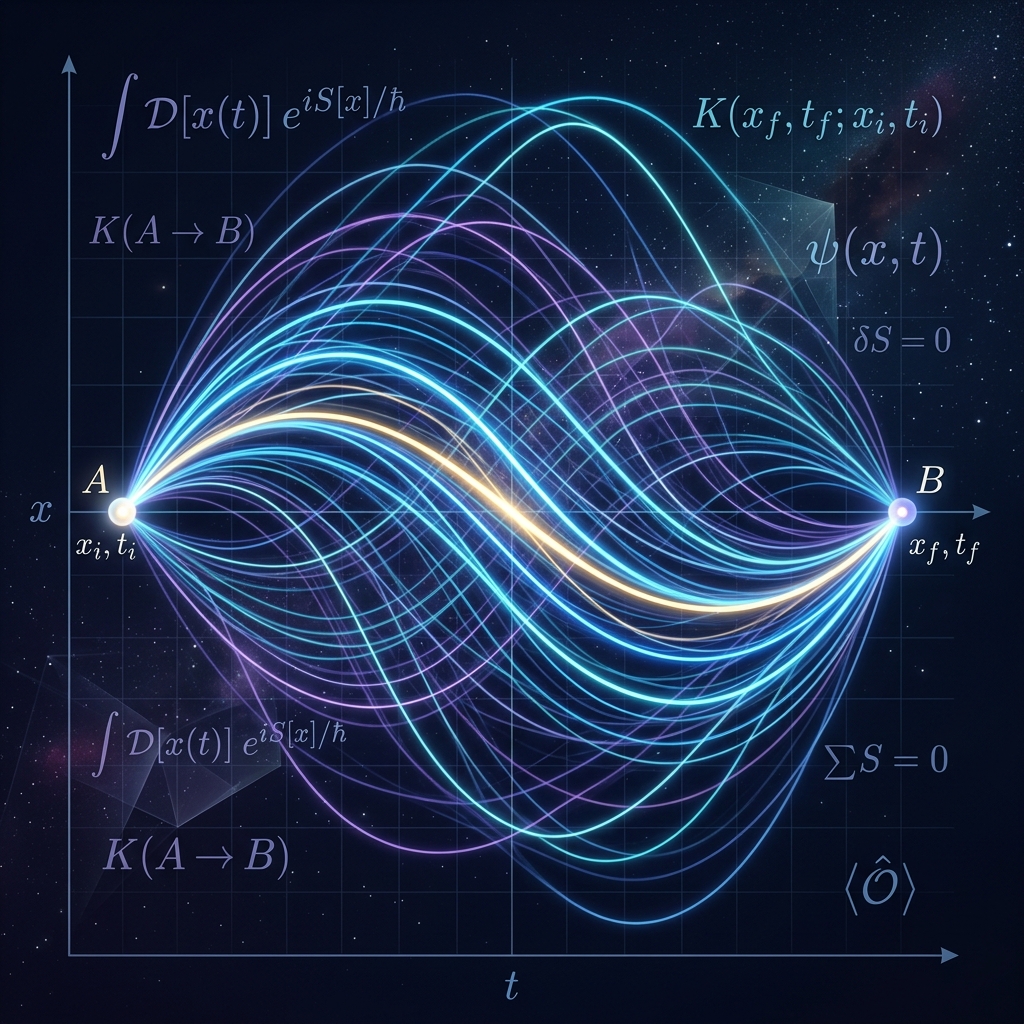
A complete, pedagogically rigorous journey through Feynman’s path integral formulation — from the simple question “how does a particle get from A to B?” all the way to Euclidean field theory, instantons, and the bridge to statistical mechanics. Every derivation is shown, every concept is motivated, every “why” is answered.
📖 Feynman & Hibbs 📖 Shankar 📖 Zinn-Justin 📖 Kleinert 🔬 15 Modules 🎯 Wick Rotation 🌀 Instantons ⚛ QFT Bridge
🗺️ What You Will Learn
This course takes you on a complete journey through the path integral formulation of quantum mechanics:
- Foundation (Modules 1–3): What propagators are, Feynman’s “sum over all paths” idea, and your first complete path integral — the free particle
- The Machine (Modules 4–7): Rigorous derivation of the path integral from operators, the harmonic oscillator, functional calculus, and Gaussian integrals — the mathematical toolkit
- Classical Meets Quantum (Module 8): How classical mechanics emerges from the path integral via stationary phase
- Into Euclidean Territory (Modules 9–11): Wick rotation, Euclidean path integrals, Euclidean equations of motion, and the spectacular physics of instantons and tunneling
- The Big Connections (Modules 12–13): The deep bridge to statistical mechanics and the extension to quantum field theory
- Frontiers (Modules 14–15): Applications to lattice QCD, quantum gravity, condensed matter, and a complete cheat sheet
By the end, you will understand why path integrals are the language of modern theoretical physics.
📐 Course Modules
Propagators & Transition Amplitudes
How does a quantum particle get from A to B? The time evolution operator, the propagator K(x_b, t_b; x_a, t_a), the composition property, and the connection to wavefunctions and Green's functions.
→ Module 2The Sum-Over-Paths Idea
Feynman's revolutionary insight: the particle takes ALL paths simultaneously. The action principle, the phase e^{iS/ℏ}, why crazy paths cancel, and a sneak peek at the classical limit.
→ Module 3Free Particle Propagator
Your first complete path integral calculation. Time-slicing, discretizing the action, doing the Gaussian integrals one by one, the continuum limit, and verification against the Schrödinger equation.
→ Module 4Deriving the Path Integral
The rigorous construction: Trotter product formula, inserting complete sets of position and momentum states, the phase-space path integral, integrating out momenta to get Feynman's Lagrangian formula.
→ Module 5Path Integral for the Harmonic Oscillator
The second exactly solvable case. Classical path + fluctuations, the fluctuation determinant, the exact propagator, recovering E_n = (n+½)ℏω, and the connection to the QHO course.
→ Module 6Functional Integrals & Functional Calculus
The mathematical language of path integrals. Functionals, functional derivatives, the Euler-Lagrange equation revisited, generating functionals Z[J], and correlation functions.
→ Module 7Gaussian Integrals & Functional Determinants
The computational workhorse. Finite and infinite-dimensional Gaussian integrals, functional determinants, eigenvalue methods, zeta-function regularization, and the Van Vleck–Morette formula.
→ Module 8The Classical Limit & Stationary Phase
How does classical mechanics emerge from quantum mechanics? The stationary phase approximation, ℏ → 0, the semiclassical (WKB) connection, multiple classical paths, and the correspondence principle.
→ Module 9Wick Rotation & Imaginary Time
The profound trick: rotate time to the imaginary axis. Why oscillating integrals become convergent, the Minkowski → Euclidean dictionary, complex analysis justification, and the physical interpretation.
→ Module 10Euclidean Path Integrals
Full theory in imaginary time. Ground-state projection, extracting energies and energy gaps, the Euclidean generating functional, periodic paths, and the partition function.
→ Module 11Euclidean Equations of Motion & Instantons
Motion in the inverted potential! The Euclidean EOM, the double-well problem, the instanton (kink) solution, tunneling amplitudes, the dilute instanton gas, and ground-state splitting.
→ Module 12Connection to Statistical Mechanics
The deepest analogy in physics. Quantum partition function as Euclidean path integral, thermal expectation values, the transfer matrix, and the quantum-classical dimensional mapping.
→ Module 13Path Integrals in Quantum Field Theory
From particles to fields. The QFT path integral, free scalar field propagator, Euclidean QFT, interactions, perturbation theory, and Feynman diagrams as a consequence of the path integral.
→ Module 14Applications & Research Frontiers
Where path integrals are used today: lattice QCD, condensed matter, quantum gravity, black hole thermodynamics, topological field theory, quantum computing, and open problems.
→ Module 15Master Cheat Sheet & Further Reading
Every formula from the course in one place. Complete Minkowski ↔ Euclidean dictionary, Gaussian integral reference, concept map, annotated bibliography, and classic papers.
→📚 Prerequisites & Textbooks
🧩 What You Should Know Before Starting
- Quantum Mechanics: The Schrödinger equation, Dirac notation \(|x\rangle\), \(\langle x | p \rangle\), time evolution operator \(\hat{U} = e^{-i\hat{H}t/\hbar}\)
- Classical Mechanics: Lagrangian \(L = T - V\), the action \(S = \int L\, dt\), Euler-Lagrange equations, Hamilton’s principle
- Mathematics: Multivariable calculus, Gaussian integrals, Taylor series, linear algebra (eigenvalues), basic complex analysis
- Helpful but not required: Quantum Harmonic Oscillator course on this site, statistical mechanics basics