Quantum Harmonic Oscillator
From Classical Springs to Squeezed Light
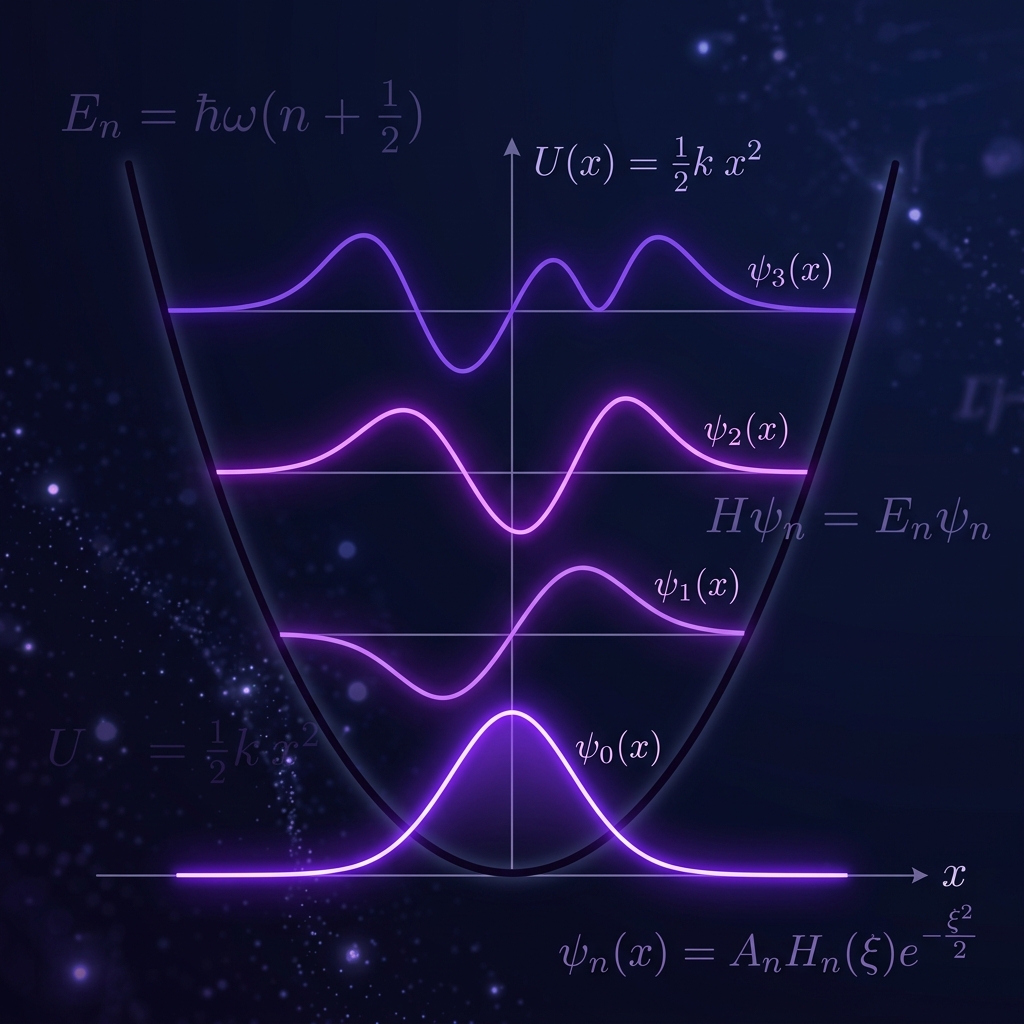
⚛️ The Quantum Harmonic Oscillator
The most important system in all of physics — from molecules vibrating in a crystal to the photons of a laser beam to the quantum noise of gravitational-wave detectors. This course builds everything from scratch, with zero hand-waving.
📖 Shankar 📖 Cohen-Tannoudji 📖 Griffiths 🔬 8 Modules 🎯 Coherent States 🌀 Squeezed States 🔭 LIGO
📐 Course Modules
Why Do We Need Oscillators?
Every stable potential looks like a spring near equilibrium. Taylor expansion argument, classical SHO review, phase space, and real physical examples from molecules to LC circuits.
→ Module 2Quantizing the Oscillator
Canonical quantization, [x̂, p̂] = iℏ, the Schrödinger equation for the QHO, power-series solution, Hermite polynomials, and the quantized energy spectrum Eₙ = ℏω(n + ½).
→ Module 3Ladder Operators — The Algebraic Shortcut
Create â and ↠from scratch. Derive the full spectrum using only commutators — no differential equations needed. Fock states, the number operator, and all matrix elements of x̂ and p̂.
→ Module 4Wavefunctions and Hermite Polynomials
Explicit ψₙ(x) from the ground state up. Nodes, parity, orthonormality, quantum tunneling, expectation values, the virial theorem, and the quantum-classical correspondence.
→ Module 5Time Evolution
TDSE for superposition states, the time evolution operator, Heisenberg picture, Ehrenfest's theorem, quantum revivals at T = 2π/ω, and the Wigner function for phase-space visualization.
→ Module 6Coherent States
Eigenstates of â. The displacement operator D̂(α), Fock expansion, minimum uncertainty, Poisson photon statistics, classical oscillation, and the phase-space picture. The quantum state of laser light.
→ Module 7Squeezed States
Beyond the Standard Quantum Limit. The squeeze operator Ŝ(ξ), Bogoliubov transformations, sub-SQL noise, sub-Poissonian statistics, and the revolutionary application to LIGO gravitational-wave detection.
→ Module 8Summary, Cheat Sheet & Further Reading
Every formula from the course in one place. Downloadable PDF cheat sheet covering all operators, commutators, wavefunctions, coherent and squeezed state properties. Plus a curated reading list.
→📚 Prerequisites & Textbooks
🧩 What You Should Know Before Starting
- Classical Mechanics: Newton’s laws, energy conservation, simple harmonic motion \(\ddot{x} + \omega^2 x = 0\)
- Linear Algebra: Vectors, matrices, eigenvalues and eigenvectors
- Calculus: Differentiation, integration, Taylor series, basic ODEs
- Quantum Mechanics (helpful but not required): The Schrödinger equation, wave-particle duality